The Breeding Aquatic Birds of Taylor Pond

by Dana Little, July 2008

Taylor Pond provides essential habitat to a variety of aquatic birds that depend upon its clean and productive waters.  Standing by the lake one can count dozens of bird species flying over, diving into, or swimming in the pond.  A short hike in any direction away from the pond demonstrates a rapid decline in the numbers and variety of birds.  Fifteen species depend on the pond to raise their young.  They typically arrive as soon as open water appears around the edges and stay until the pond surface freezes solid.

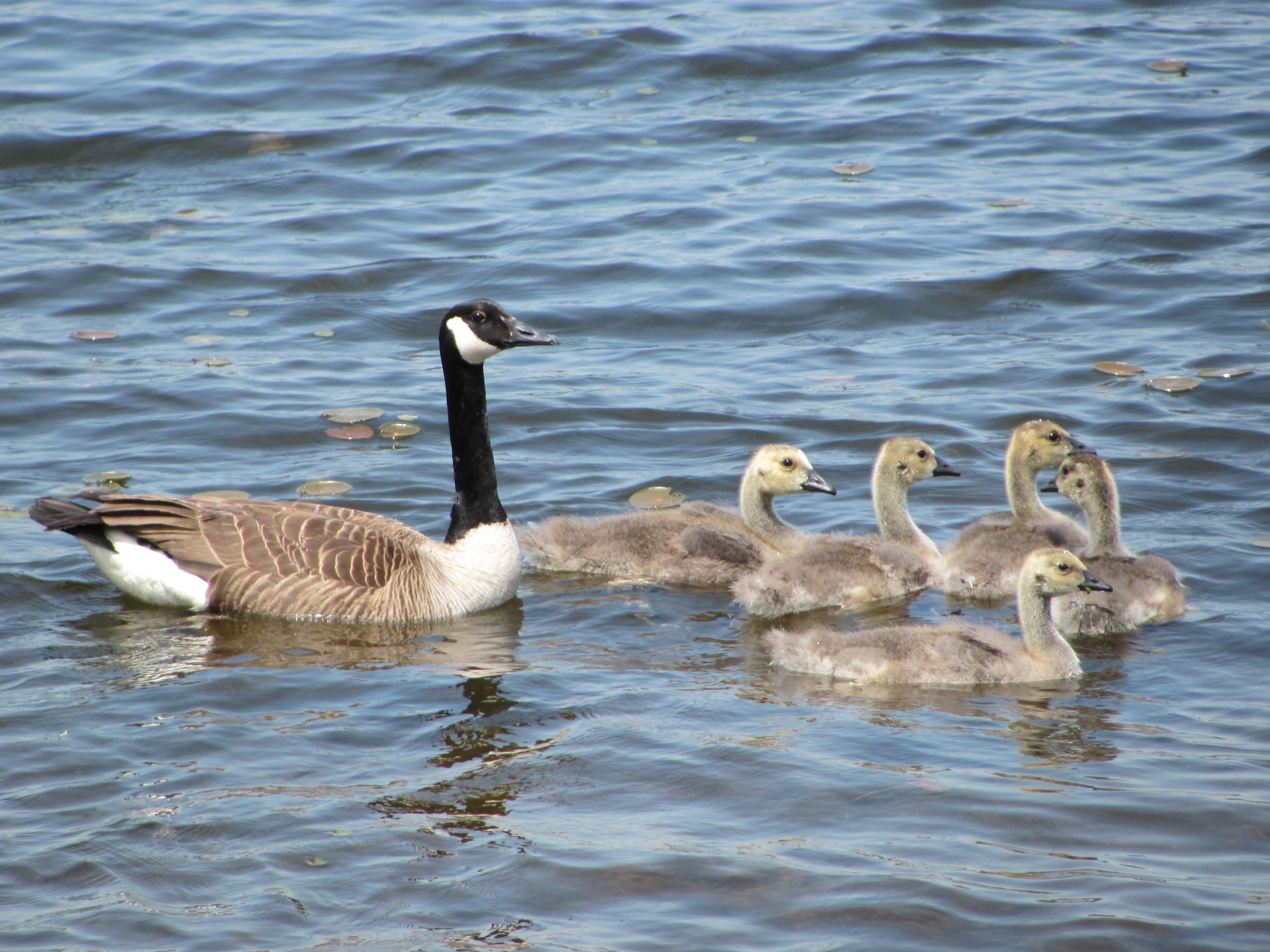
A pair of Canada Geese in recent years has been nesting on the pond.  The male and female will form a pair that lasts for years.  They lay 4-7 eggs and then share in raising the young.  They often will climb onto lawns that reach all the way to the water.  They will forage on sprouting vegetation and insects found on lawns leaving large fecal messes that can be hazardous to people walking on the lawn.  Large flocks stop off to rest on the pond during migration north in the spring and south in the fall.
Bird Geese

A family of Canada Geese

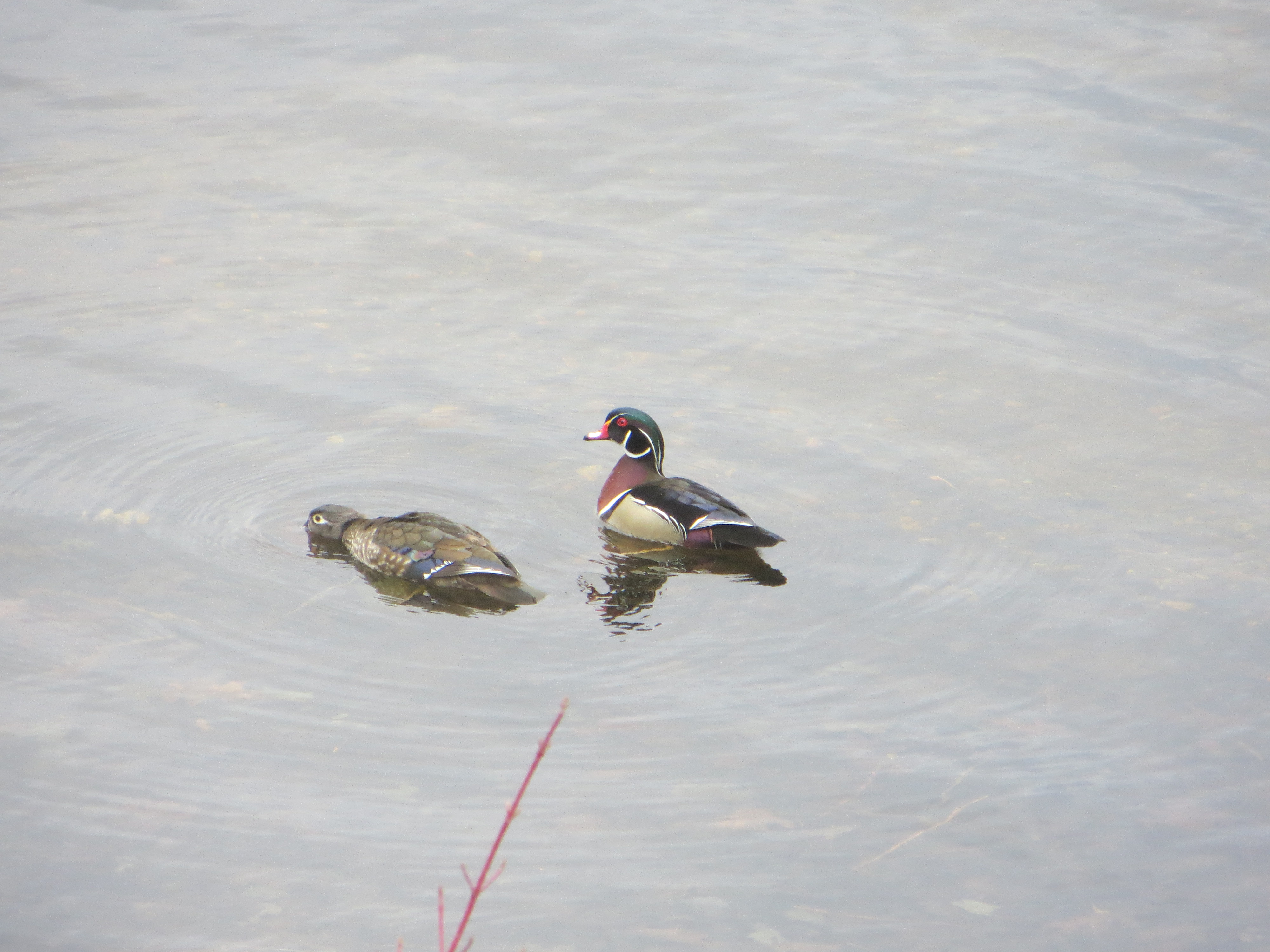
Four ducks commonly breed on the pond:  Wood Duck, American Black Duck, Mallard, and Hooded Merganser.  The Black Duck and Mallard stay year round.  During the winter they swim in openings of the ice on the pond until they close up, and then they move to the AndroscogginRiver or down to the coast.  The Wood Duck and Hooded Merganser slip down to the southern United States for the winter,,  but as soon as open water occurs, they reappear.  The Wood Ducks can be found in the spring sitting in pairs in large trees around the pond.  They like nesting in hollow cavities in old trees, but love it if you provide a nesting box for them.  Nests will often contain 15-20 eggs, sometimes from multiple females. The adults and young commonly forage for small invertebrates in the marshes and swamps around Taylor Pond.  The secretive Wood Duck, although common, takes an alert observer to spot them before they rapidly fly away when approached.  The Hooded Merganser also nests typically in hollow trees or nesting boxes.  Up to 35 eggs, which may be laid by several females, have been found in their nests. Hooded Mergansers have been known to lay their eggs in Wood Duck nests.  Hooded Mergansers have narrow serrated bills to capture the small fish, frogs and crayfish that form the bulk of their diet.  They are secretive birds that are best seen early in the morning or late in the evening diving for their prey in open water.  The Black Duck and Mallard will typically lay 8-10 eggs in a grass lined nest usually found in a remote marshy area.  Once the young hatch they are commonly seen throughout the day on open water of the pond, the female leading and a long line of young following behind.
Bird Wood Ducks courting

Courting Wood Ducks

Common Loon eggs have been found around the pond in the last two years.  However, we have not had a successful chick since Audubon volunteers has been monitoring the pond since 1983.  I suspect that the lack of breeding success has to do with too many houses along the shore, too much boat traffic, and in the last few years, jet skis that regularly buzz the entire shore line.  During the summer a careful search of the pond will usually find 4-6 Common Loons foraging for their favorite food of small fish.  They appear tame and are easily approached in a canoe or may suddenly appear close to you while you are swimming.

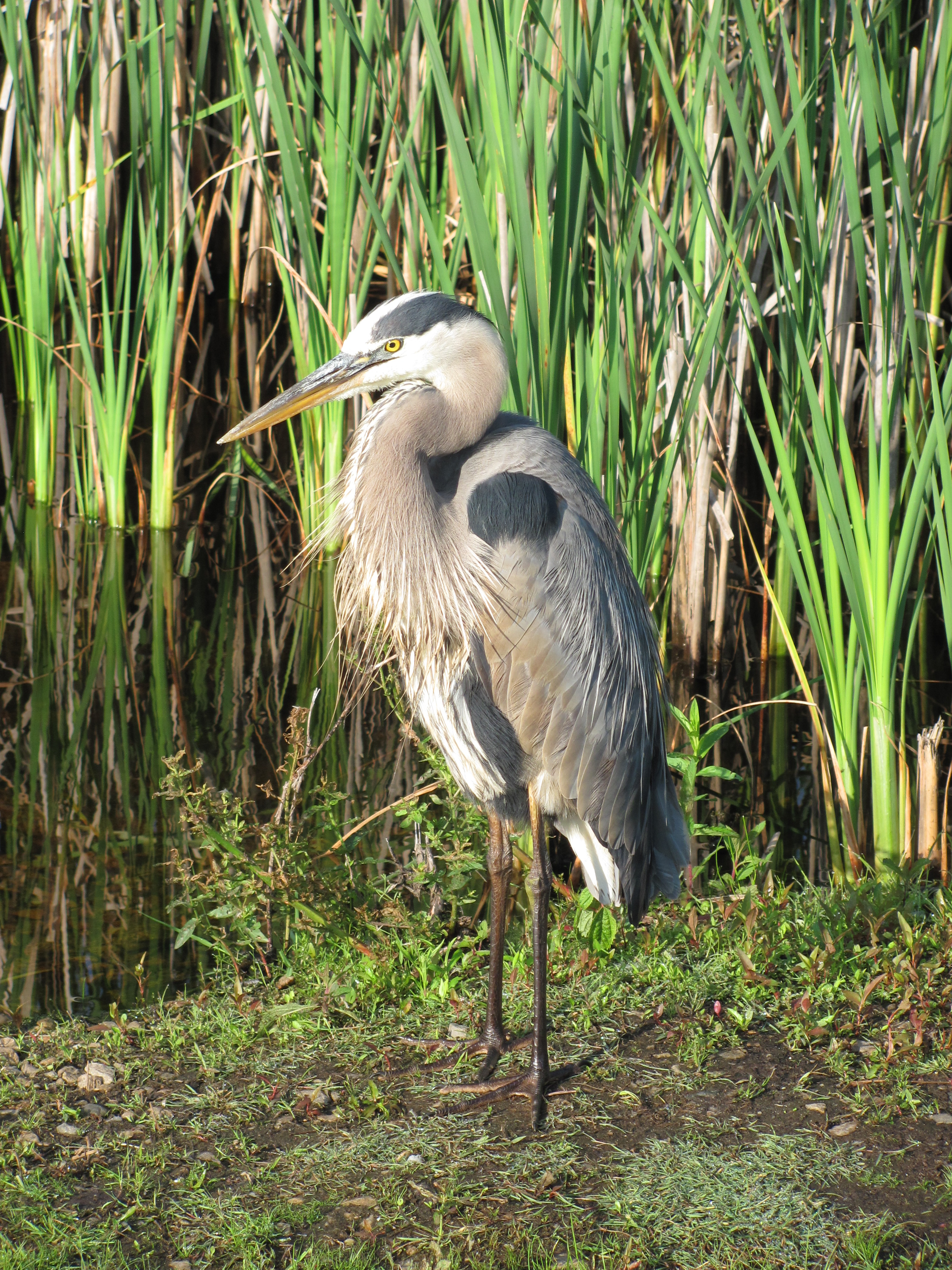
Great Blue Herons nest in colonies, the closest one being on an island in the AndroscogginRiver.  At daybreak the Herons leave their nesting and roosting sites to feed in places like Taylor Pond.  During the daytime, Great Blue Herons can often be found standing in shallow water along the shoreline looking for their favorite foods; fish, frogs and crayfish.  One day I watched a Great Blue Heron at the end of my dock work for over one-half hour swallowing a foot long prickly perch.  The much smaller Green Heron typically nests in thickets in marshy areas.  Difficult to find, one usually spots them feeding along natural shorelines, climbing up on overhanging shrub branches, waiting to spear any fish that swim below.
Bird Great Blue Heron

Great Blue Heron

American Bitterns breed in the marshy areas on the side of the pond.  Almost never seen, their presence is most commonly noted by their deep booming calls that have an other-worldly nature to them.  They feed on small fish, frogs and crustaceans found in the marsh or along the sides of the pond.  The Virginia Rail is one of the most difficult-to-spot birds of the pond.  They spend all their time in thickets in the middle of the marsh.  Their unusual call is commonly heard and once you recognize it you may see them walking about low in the bushes.  They are not shy and will parade out in front of you with no apparent fear if you remain still.  When we moved into our home here on the pond, one adult led and one adult followed with 10 young in between parading around the moving vans.  The young look like black, fluffy ping-pong balls on stilts.  Once fully grown they fly off to winter along the southern and gulf coast of the US.

It takes an alert observer to see the common Spotted Sandpipers which are usually seen feeding along the shoreline.  Their constant bobbing and black spots on a white belly identify them.  They breed in the woods and fields around the pond.  They win the prize for aquatic birds flying the furthest as they commonly winter in Chile and Argentina.

Ospreys typically build large stick nests near the water.  I have seen no nests near the pond but they can be seen daily catching fish.  They hover over the water 30-100 feet and then dive feet first to come up with wriggling perch and bass.  The Osprey population plummeted in the 1950’s due to DDT but now they are abundant in Maine.  During the winter, they travel down to the coast and as far south as South America.  The largest bird found on Taylor Pond, the Bald Eagle, has a wingspan typically over six feet.  Their nests can be found on the AndroscogginRiver, but they are regularly seen hunting over the pond.  They feed on fish sometimes stolen from Osprey or snatched from the water.  They also love to feed on gulls, ducks, and small mammals.
When Green is Not So Green

by Anne Goorhuis, May 2007

To be green is to be seen as eco-friendly.  A green choice protects the environment and doesn’t deplete the earth’s natural resources.   Sprinkle the word green in your conversation enough, and your colleagues will begin to view you as an avant-garde who’s into cutting edge, petroleum-saving technologies.  Yes, green is the new adjective to describe an environmentally friendly, sustainable lifestyle choice.  Unfortunately, green is also used to describe grass.

Green grass…sigh!  It conjures up images of barbecues and hammocks.  Green grass seems to summarize what so many of us strive for – beautiful surroundings and the time to enjoy them!  We dream of a golf-course quality lawn and pursue that dream at any cost.  However, there are some underlying assumptions about perfect lawns that do not harmonize well with lakeside living.

The golf-course-quality, green lawn is one of monoculture, where one characteristic is emphasized to the detriment of other characteristics.  The chemical companies have taught us that uniformity of appearance is better than diversity of plant species.   If we sprinkle a little of this or spray some of that, we can get rid of the clover in the grass, for example.  Clover’s broadleaf image doesn’t jive with the slim, anorexic look of a blade of grass.  The lake-lover, however, comes to appreciate clover because of its ability to bind nitrogen to the soil – a kind of self-fertilizer, if you will.  The lake-lover realizes that to use an herbicide to get rid of the clover affects the lake, because the chemicals can leach into the water and cause problems for the fish, which in turn can cause problems for the beings that eat the fish.  DDT is a prime example.

A lakeside environment is one of diversity.  The above example illustrates how sensitive our unique environment is.  This complex interplay is one of the reasons we Taylor-Ponders love living here.  I, for one, get a thrill from watching a Bald Eagle perched on a nearby tree looking for chemically untainted fish!  (And should the fish become tainted, how long until there are no more Bald Eagles?) When we choose to give up the unrealistic dream of monoculture, we say “Yes!” to the multilayered environment that is our home.

So here are a few pointers for those of us who want to walk barefooted to the grill to get our hamburger and still have something grass-like under our feet.

1)     If you’ve got enough sun on your property to grow grass, vow never to use an herbicide on it.  Adjust your expectations to allow a few broadleafs in your lawn.

2)     Let your grass grow to at least 3” in length before mowing and allow the clippings to fall on the lawn to fertilize it.

3)     Only water your lawn if it hasn’t rained in seven days.  In this case, water before 10 a.m. for a longer period of time (30-60 minutes).  This creates deeper root systems on the grass that withstands drought better.

4)     Do not mow within 15 -20 feet of the water.  Instead allow a natural buffer to flourish there.  Even a buffer of 8-10 feet is better than nothing.

5)     If you do not have enough sun to properly grow grass, don’t spend lots of money on useless fertilizers trying to do so.  All those chemicals end up in the lake and you still won’t have that coveted lawn. (A future article will deal with options for the yard with dense shade.)

6)     If your property touches the waterfront, don’t use any fertilizers.  Instead, do not bag the grass clippings and shred your leaves in the fall.  Allow the shredded leaves to lie on the lawn over the winter.  This is a form of natural fertilizer.  For flower and vegetable beds use organic fertilizers such as a compost of leaves, grass clippings and household vegetable waste.

7)      If your property is not contiguous to the lake or a stream that feeds into the lake, and you feel the lawn occasionally needs the burst of a fertilizer; purchase phosphorous-free fertilizer.  Do not apply fertilizer after midsummer, as plant growth then starts to wane in preparation for autumn and winter and more chemicals are therefore leached into the ground table or lake.

These websites were helpful to me in preparing this article:  www.reduce.org/garden/

and www.mindfully.org/Sustainability/Sustainable-Lawn-Care.htm .   Happy grilling!

TAYLOR POND ASSOCIATION WINS MAINE COLA STEWARDSHIP AWARD

by Michael Dixon, May 2007

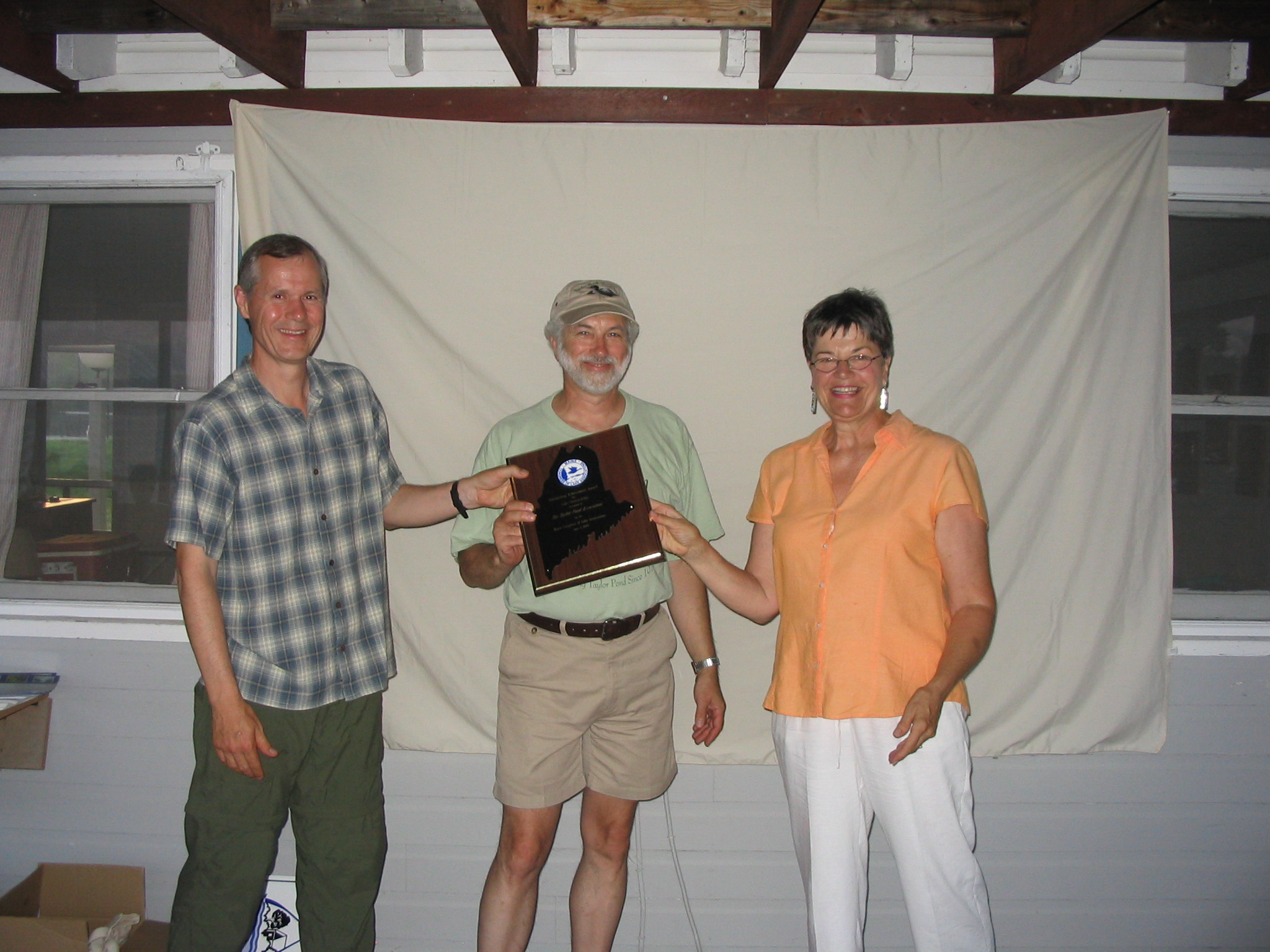
Each year, the Maine Congress of Lake Associations recognizes a lake association for its contribution to protecting Maine lakes and ponds.  I am very proud to report that we won the 2006 Outstanding Achievement Award for Lake Stewardship.  The award was announced at the 2006 New England Lakes Conference, held in Farmington on Saturday, June 3.  Dana Little and I attended the conference in order to accept the award.

Award

Maggie Shannon presents the award to Michael Dixon and Dana Little.

I thought I would use this opportunity to tell you all a little about the organization that honored us, by including some information from the COLA website:

What is Maine COLA?

The Maine Congress of Lake Associations (Maine COLA) was formed in 1970 as a non-profit, charitable organization for Maine lakes. It is the only statewide network of individuals and lake associations devoted solely to the protection and preservation of our lakes.

Protecting water quality and promoting sound land-use practices are objectives Maine COLA has had throughout its history. More specifically the purposes of Maine COLA are:

  • To provide a communication network and coordinating structure for      lake-related projects and issues;
  • To provide a clearinghouse of environmental information pertaining      to lake management;
  • To provide a pool of technical knowledge and expertise to advise      and assist members;
  • To promote through education the appreciation and wise use of      Maine lakes;
  • To promote boating and water safety;
  • To establish liaisons with other environmental groups and      agencies;
  • To monitor and report to members on legislation and administrative      actions affecting Maine lakes; and
  • To advocate and support legislation and administrative actions      which promote sound lake management.

What Does Maine COLA Do?

From testifying at a legislative hearing or hosting a conference on sewage disposal to alerting members about important lake issues throughout the state, Maine COLA’s activities are as varied as its accomplishments.

Maine COLA has always had a strong commitment to individual lake associations: how to start one, where to obtain water monitoring equipment, how to reduce erosion. While lake associations have concerns unique to their lakes, there are common statewide problems as well. Maine COLA serves as a resource for both.

We are also active with legislative issues. In the mid-1970’s Maine COLA was influential in obtaining comprehensive legislation regarding dams and water levels, unchanged for centuries, which led to required water levels and better dam safety. Maine COLA is a member of the Great Ponds Task Force, charged with developing a package of recommendations which was passed by the Maine 118th Legislature in 1998. Supporting legislation for the welfare of our lakes continues to be an important component of Maine COLA.

The TPA is a dues-paying member of COLA, but the organization also offers individual memberships.  Please visit www.mainecola.org for more information.

The Gulls of Taylor Pond

by Dana Little May 2007

Officials responsible for LakeAuburn’s water quality decided a year ago that gulls were increasing the bacterial count in Lewiston/Auburn’s water supply.  To reduce this source of pollution, Ben Nugent of Maine Fish and Wildlife Service killed a few gulls.  He also used noise-makers to scare many more gulls off the lake.  Officials successfully reduced the gulls on LakeAuburn and bacterial counts declined to acceptable levels.  However, the reduction in gulls on LakeAuburn appeared to have caused an increase in gulls on Taylor Pond.

This last summer Ben Nugent observed an increase in gulls on Taylor Pond.   The number of gulls counted on Taylor Pond ranged from 50 to a high of 3,000.  Typically he counted 800 gulls in the evening floating on the water this last summer.  He saw higher numbers during the migration of Herring Gulls in the fall.  When the ice covers the pond in the winter, most of the gulls leave the pond.  Some gulls remain and will roost at night out in the middle of the ice where they feel the safest.  Ben has observed flocks of gulls traveling down the AndroscogginRiver daily in the winter to roost in the ocean.  He speculates that they travel to the ocean because they feel safer roosting out on the ocean where they can easily spot approaching predators.  During the day, gulls fan out across the countryside to forage in farmer’s fields, open dumpsters and roadside trash.  In the summer, gulls gather over the pond in the evening, circling above looking for danger.  When they feel safe, they settle down in the middle of the pond to roost for the night.

We need to be concerned about the increase in gulls for two reasons.  First, their feces are loaded with bacteria which have the potential to make people sick when they swim or drink the water.  Reassuringly, two years ago, tests done on the water in Taylor Pond during the summer swimming season did not show any significant levels of bacteria.  Taylor Pond Association’s board recently made a decision to perform bacterial testing this coming summer to see if the increase in gulls will cause a problem.  Secondly, gull feces are high in nutrients, including phosphorous, which could cause an algal bloom.  However, ongoing testing for phosphorous levels in Taylor Pond demonstrated no increase from the gulls.  After learning about the potential problems that gulls can bring, we might be tempted to chase them off the lake to prevent problems from occurring.  Ben Nugent, who manages the gulls on LakeAuburn, reminds us that we cannot disturb wildlife without a permit and gulls are protected under the Migratory Bird Treaty Act.

Gulls provide entertainment for those of us watching the wildlife.  Year-round, one can often spot Ring-billed Gulls around the pond.  During migration many Herring Gulls appear and a few Great Black-backed Gulls show up throughout the year.  During a large mayfly hatch this past summer, large numbers of gulls swept through the air at dusk, feeding on the mayflies.  As it became dark, bats moved in and cleaned up what the gulls did not eat.  This winter Tim Priestly observed a Bald Eagle chasing down and devouring a gull on the ice in front of his home.  Charlie Todd of Maine Fish and Wildlife tells me that along the ocean shoreline gulls make up 50% of the Bald Eagles’ diet.  Fortunately, we have spotted many Bald Eagles year-round on Taylor Pond, perhaps they will keep the gulls from overwhelming the pond.

The Taylor Pond Association board will continue to monitor the gull situation and will review the data to be collected this summer regarding bacterial count.

Glossary of Lakeside Living Terms

by Anne Goorhuis 

As property owners living adjacent or close to the lake, we are all interested in maintaining a clean, algae-free Taylor Pond for our own enjoyment and to maintain the property values of our homes.  What follows is a glossary of must-know terms of the eco-speak of lakeside property care.

THE COMMON RAINDROP – The common raindrop is public enemy number one to maintaining water quality because of the following:  Rain carries soil down to the lake.  Soil binds with phosphorous and carries it to the lake.  High levels of phosphorous in a lake create algal blooms.  An algae bloom lowers property values and lessens our personal enjoyment of the lake.  See Erosion Control, Storm Water, Open Box Culverts, Phosphorous 

PHOSPHOROUS – The measurement of phosphorous is considered to be the most reliable measure of a pond’s capacity to have an algal bloom.  Thus any use of fertilizer (the most common way ponds get contaminated) should be judiciously weighed.  Test your soil via the Maine Extension Service, and amend only the recommended factors.   When reading a bag of fertilizer, such as 15 – 10 – 12, the middle number stands for Phosphorous.  Indiscriminate use of 20-20-20 fertilizer can be deadly to a lake!  If a soil test shows you need soil amendments, use slow-release products like bone meal, bloodmeal, or cottonseed meal.   Compost is the perfect amendment because it increases the soil’s capacity to hold water, yet keeps soil workable.  By the way, ponds with phosphorous levels below 15 are considered to be unlikely to have an algal bloom.  Taylor Pond’s mean (since 1975) is 11.  Kudos to us!  Let’s keep up the good work!

See The Common Raindrop, Storm Water, Erosion Control 

STORM WATER – Lengthy rains and down pours create storm water, i.e. precipitation that cannot be absorbed immediately by the soil.  How a property within a watershed handles storm water has a direct bearing on lake water quality.  Storm water that creates ruts in dirt roads only to be directed the shortest way possible to the lake carries loads of unwanted phosphorous into the lake.  Storm water that is diverted off the road into vegetated areas or catch basins, allows the soil to settle out and the water to filter before entering the lake.  Storm water coming off rooftops and driveways carries similar implications.  See Open Top Culverts, Level Lip Spreaders, Rain Gardens, Buffer Strips, Vegetated Buffers 

EROSION CONTROL – Erosion control methods allow storm water to be diverted to vegetated buffers or holding areas.  This cuts back on the quantity of soil displaced and keeps what has been displaced out of the lake.  The goal of erosion control is to allow storm water to be either spread out, filtered out, or absorbed.  All three goals keep the common raindrop from carrying phosphorous into the lake.   See Open Top Culverts, Level-lip Spreaders, Vegetated Buffers, Rain Gardens 

RAIN GARDENS – Rain gardens are natural or man-made depressions in the lawn area planted with attractive plants.  Water puddles here temporarily during times of rain.  To the lake, the advantage of a rain garden is that the roots of the plants absorb more water than mere grass.  To the homeowner, the advantage is more attractive landscaping surrounding the home.  Email the lake association if you would like a photocopy of example rain garden layouts.  See Erosion Control, The Common Raindrop 

OPEN TOP CULVERTS – Open top culverts are the opposite of a speed bump; they are dips in a dirt road that funnel storm water off the road into vegetated areas to be absorbed or filtered.  Normally constructed out of pressure treated wood, they are open at the top, and do require emptying once dirt settles into them.  This drawback is counterbalanced by the fact that open top culverts slow down the formation of unwanted ruts and potholes.  To view an open top culvert, travel West Shore Drive, Waterview Drive, Willard Road or the dirt portion of Taywood Road.  See Erosion Control 

LEVEL-LIP SPREADER – A level-lip spreader is essentially a catch basin with one important difference.  All rainwater flows down hill and some storms are so lengthy or intense that a ditch will fill up before a storm is over.  A level-lip spreader allows fast-running, soil-containing rain water to be diverted into it, creating a large, deep puddle.  Now that the water has slowed its speed, the dirt can settle to the bottom of the level-lip spreader, and cleaner water can flow out of it over a 6 foot to 12 foot lip (which is level) into a vegetated buffer and finally into the lake.  A wide band of slow flowing water is always preferable to a narrow band of quickly flowing water when it comes to lake water quality.  The water in the level-lip spreader is temporary, drying after a few days.  Knock on the door of 97 Taywood Rd. for a tour of the level-lip spreader on the author’s property. See Vegetated Buffer, Erosion Control 

VEGETATED BUFFER –  Ideally, the lakefront home will have three tiers of vegetation at the water’s edge;  mature trees, undergrowth of  younger trees or bushes and  the lowest level consisting of grasses, ground covers or low care perennials such as day lilies, hostas and sedum.   The more vegetation on the edge of the lake or near the end of an open top culvert the better, because vegetation encourages the absorption of water from the soil and the plants can use the phosphorous deposited there during times of storm water.  A “no-mow” policy is recommended for the first twenty feet of land along the length of the water’s edge, but an 8’ or 10’ buffer is also a great start.  This is also called a buffer strip.  On our property, when I decided to no longer mow at the water’s edge, I planted a row of low-care, long blooming day lilies to separate the “untidy” long grasses from the lawn chair area.  See Erosion Control, Level-lip Spreader, Open Top  Culvert, Phosphorous

NONPOINT SOURCE POLLUTION – To understand this term, consider the opposite:  If you can stand and point to a source of pollution such as a factory, farm or oil spill it is not nonpoint source pollution. Nonpoint source pollution is all the little stuff of modern living that does, in fact, add up and negatively affect the quality of our lake.  Examples include: rain coursing down our gutters and washing out the landing, the dirt churned up with rainwater in the ruts of dirt roads, home construction without the proper soil containment devices, the residual oil left in the lake from boat motors, the dust and tree dirt from our driveways.  These all have an effect. “Do we just stop living?” you may ask in frustration.  “No!” but we can choose to handle these minor sources of pollution as responsibly as possible.

Each property owner on or off the lake can allow the natural hollows in the lay of the land to remain, or create artificial ones via a rain garden.   Each property owner along a dirt road can choose to handle the storm water responsibly on his or her section.  Each lakefront owner can choose not to mow 8 feet next to the lake and to maintain their boats properly.  Knock on the door of 104 Terrace Rd. for a tour of how one homeowner manages the rain water off her section of dirt road.  

In conclusion, I hope some of you will hop in your car and tour some of the features mentioned above.  Or take some affirmative action, and sign up for the two hour LakeSmart presentation to educate yourself.  Lake living is worth an investment of time and effort!  Collectively a difference can be made!

Taylor Pond Good Habitat for Alewives

by Dana Little May 2007

In late summer, schools of alewives swarm by the shore; all moving in the same direction, thousands upon thousands of silvery fish about 2 inches in length. You can see them from afar, their silvery sides reflecting the sunlight.  The water appears to boil with them.  Pickerel and bass thrust into their midst, creating sudden swirls of water.  Kingfishers dive-bomb them from above; loons and mergansers swim to feed upon them.  Alewives grow to adulthood in the ocean far away but come home to Taylor Pond to breed.

Alewife

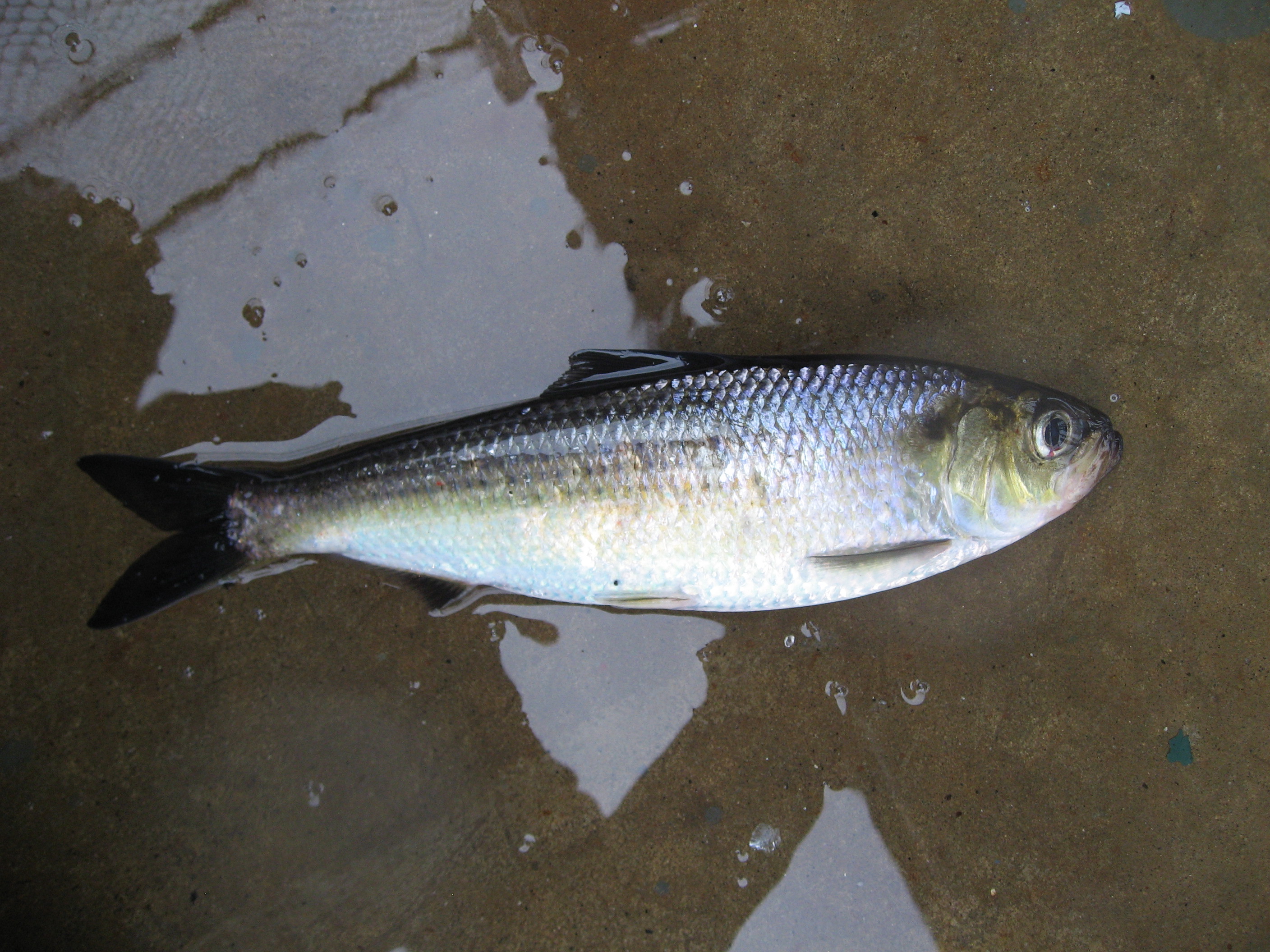
Alewife caught at Brunswick Dam Fish Ladder.

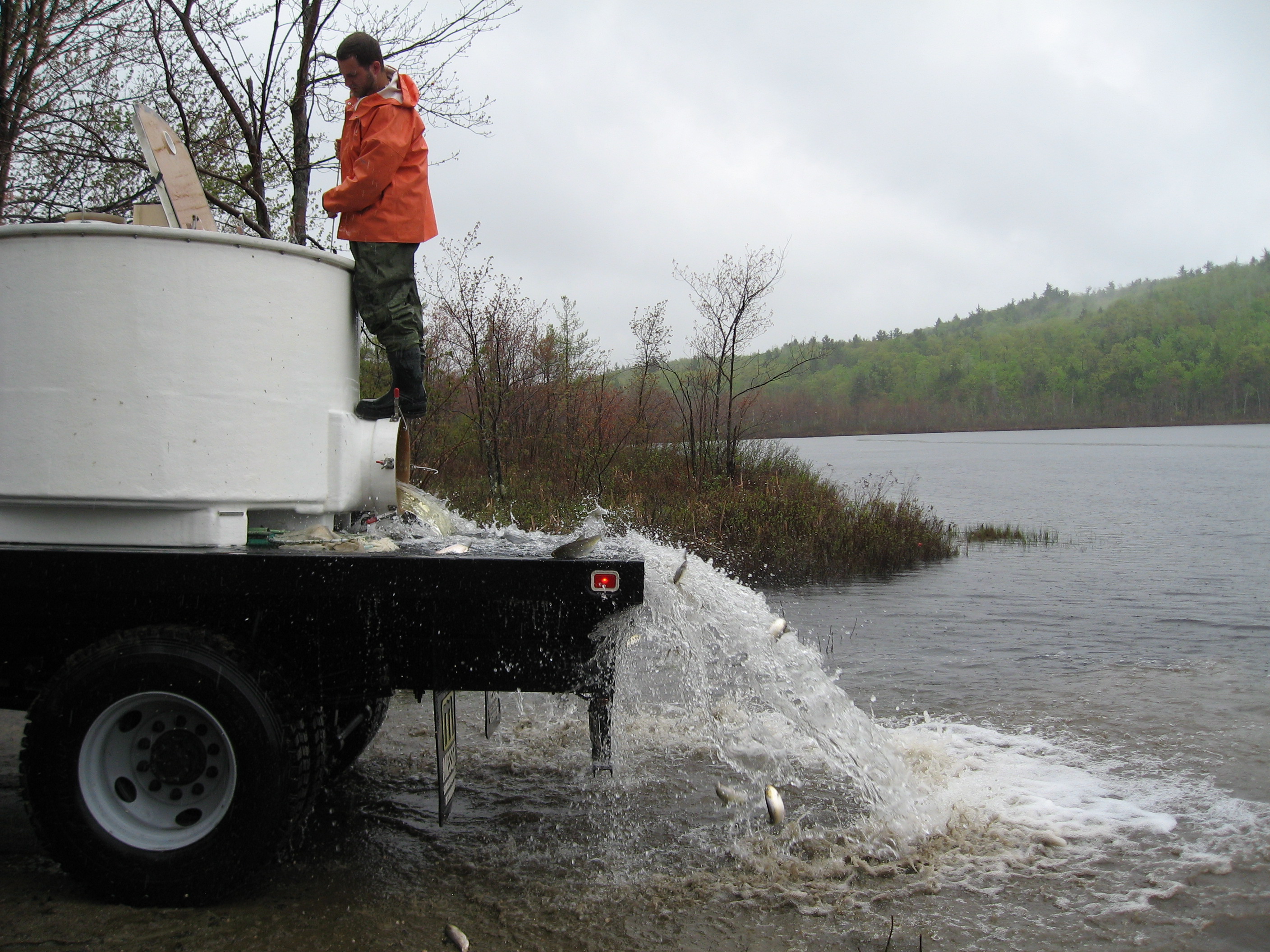
Mike Brown of the Maine Department of Marine Resources has stocked Alewives in Taylor Pond since 1999.  This stocking program brings in about three-thousand fish into our pond every year.  In the spring, usually starting after the first week in May, the adult alewives head up the AndroscogginRiver from the ocean towards Taylor Pond.  They recognize the distinctive “scent” of Taylor Pond in the water pouring out of MerrymeetingBay at PophamBeach. They swim all the way up to the Brunswick Dam which stops them.  The Department or Marine Resources catches them at the Brunswick fish ladder and trucks them up to Taylor Pond.  Adult alewives are nearly a foot in length and over a half-pound in weight.  Mike unloads the fish into the pond to provide what he considers its carrying capacity of approximately 6 fish per acre.

Alewives  dumping

Dumping Alewives into Hooper Pond

The adult fish remain in the pond 3-4 weeks, laying eggs and feeding.  The adult fish return by way of Taylor Brook down to the AndroscogginRiver and back to the ocean.  The young hatch from the eggs and grow up to be the silvery fish that we see late in the summer.  They feed on the zooplankton (microscopic animals) that grow abundantly during the summer.  Mike samples the larval fish as they migrate down Taylor Brook during the summer and fall when they return to the ocean.  He will come 40-50 times during the summer to measure Taylor Pond’s production of alewives.  Mike considers Taylor Pond to be good habitat due to its shallow water, warm temperature and the small size of the pond.

Once the young fish return to the ocean, they feed and grow rapidly for the next 3-4 years.  Scientists call fish that live most of their lives in the ocean but that return to fresh water to breed anadromous.  Alewives share this trait with brown trout, Atlantic salmon and the American eel.  Locally, scientists consider the alewives to be the most abundant anadromous fish.  Historically, Native Americans and early European settlers highly valued them for food.  A variety of animals prey upon alewives including our resident bass, pickerel and pike.  In the ocean a variety of commercially harvested fish depend upon alewives as food.  In the 1970’s annual harvests of alewives in Maine exceeded 3 million pounds, more recently fisherman have harvested less than a million pounds.  Harvested alewives currently serve primarily as bait fish for lobster traps.  On our pond a variety of birds including loons, mergansers, kingfishers and herons enjoy the fish.  Otter and mink also can be seen feeding on fish.

The alewives’ highly developed olfactory sense, their sense of “smell”, tells them which river has Taylor Pond water mingled with it.  Thus each spring they choose to travel up the Androscoggin to return to Taylor Pond.  Someday we hope that these fish will once again be able to complete the entire journey independently.  For now, we depend on the Department of Marine Resources to maintain the population of this fantastic fish.  And the Department depends upon us to keep Taylor Pond a prime habitat for the fish.

Nature on Taylor Pond 2006

by Dana Little March 26th, 2006.

Taylor Pond provides habitat to a great diversity of plants and animals.  Birds represent the largest group of vertebrates; I have counted 147 species in the area over the last 6 years, and I consider myself a casual birder.  Ninety-three species can be found here during their breeding seasons.  Large numbers of birds stop during their spring and fall migrations to and from their northern breeding grounds.  On Memorial Day weekend, 2005, I worked at home all weekend, tied to the phone.  Every few hours I would go outside to listen and watch the tremendous congregation of birds in my yard.  I counted 77 different species of birds that weekend, including15 different species of warblers.  Warblers typically live in Central and South America for the winter and travel north to breed.  They appear when the leaves start coming out and the black flies can be found in abundance.  Some of the more notable breeding species of birds that can be found around the pond include the Wood Duck, Hooded Merganser, American Bittern, Green Heron, Osprey, Bald Eagle, Virginia Rail, American Woodcock, Yellow-billed Cuckoo, Barred Owl, Yellow-bellied Sapsucker, Common Raven, Winter Wren, Rose-breasted Grosbeak, Bobolink, Baltimore Oriole and 8 species of warbler: Yellow, Chestnut-sided, Black-throated Blue, Black-throated Green, Black-and-white, Redstart, Northern Waterthrush and Yellowthroat warblers.

Bird Baltimore Oriole

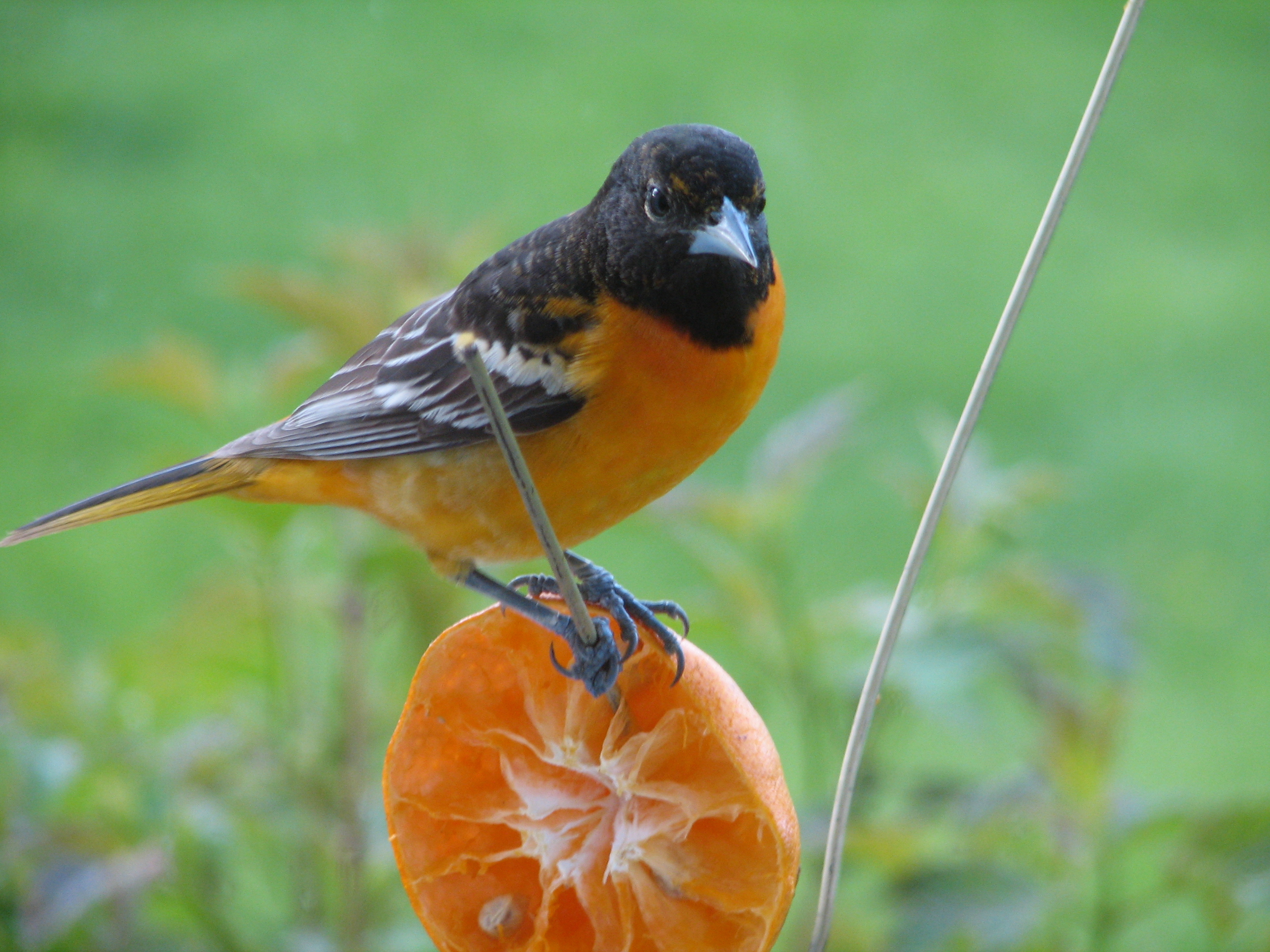
Hang an orange on an old coat hanger and the Baltimore Orioles will come to you.

Because mammals are shy, they are less frequently observed and there are less species of mammals than birds found locally, 19 seen by myself in the last 6 years.  They usually travel and feed at night, quickly leaving when the slightest noise is made.  Beaver, Muskrat, Chipmunks, Red and Gray Squirrels are common here.  Less frequently seen, but still common are the Otter, Mink, White-tailed Deer, Red Fox, Coyote, several species of Bats, moles, voles, shrews and mice.

Taylor Pond has a variety of fish. Biologists have gill-netted 11 different species.  There are many smaller species of fish that often migrate in large schools or live in the shadows of the lillypads that have not been identified.  The fish most appreciated by the fisherman are the Small-mouth Bass, Chain Pickerel and Yellow Perch.  Brook Trout can be found in the small feeder streams.  Brown Trout were once stocked and caught years ago; I am not aware of any being caught in recent years.

Fishing (2)

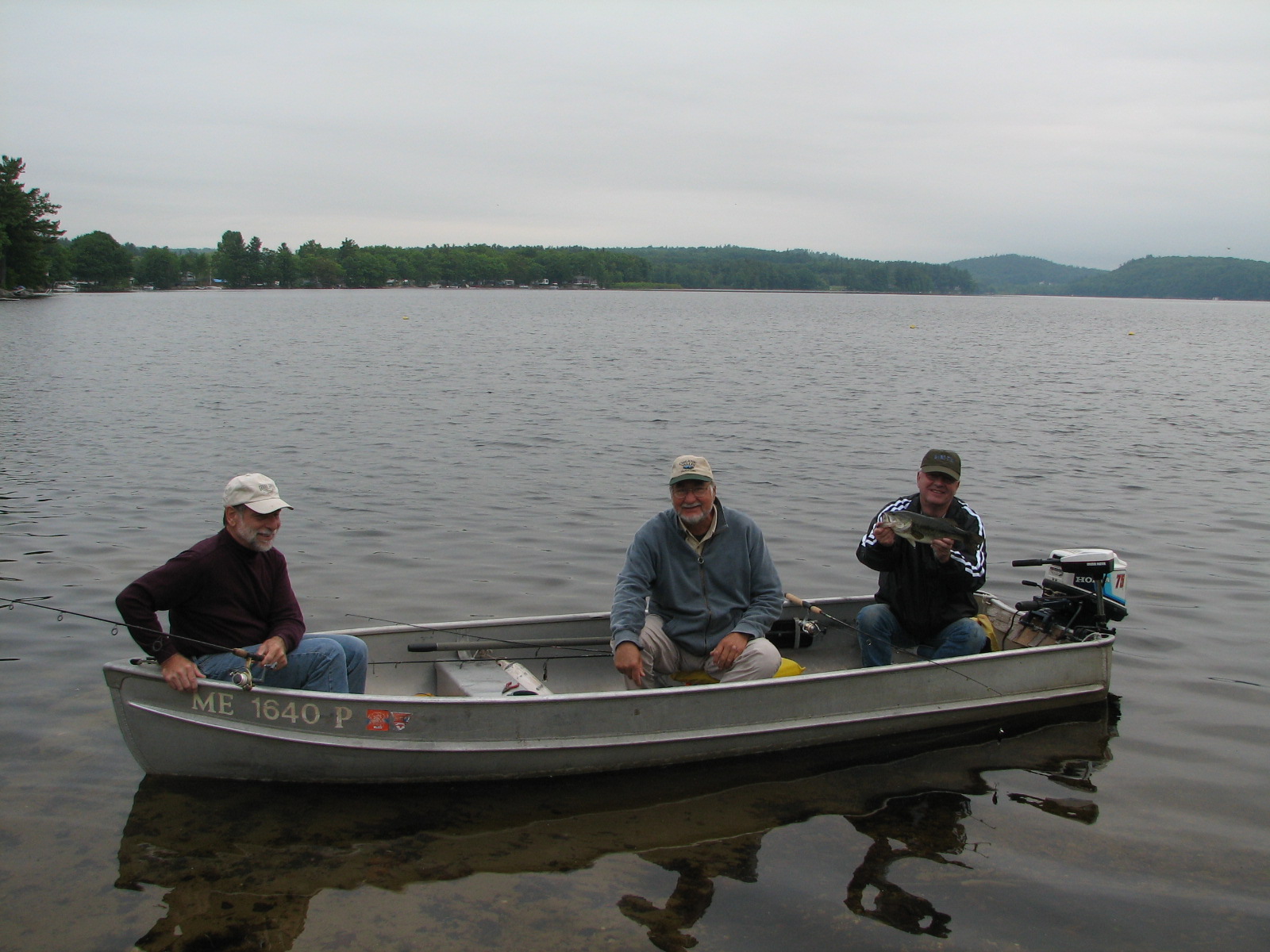
Successful Bass Fishermen

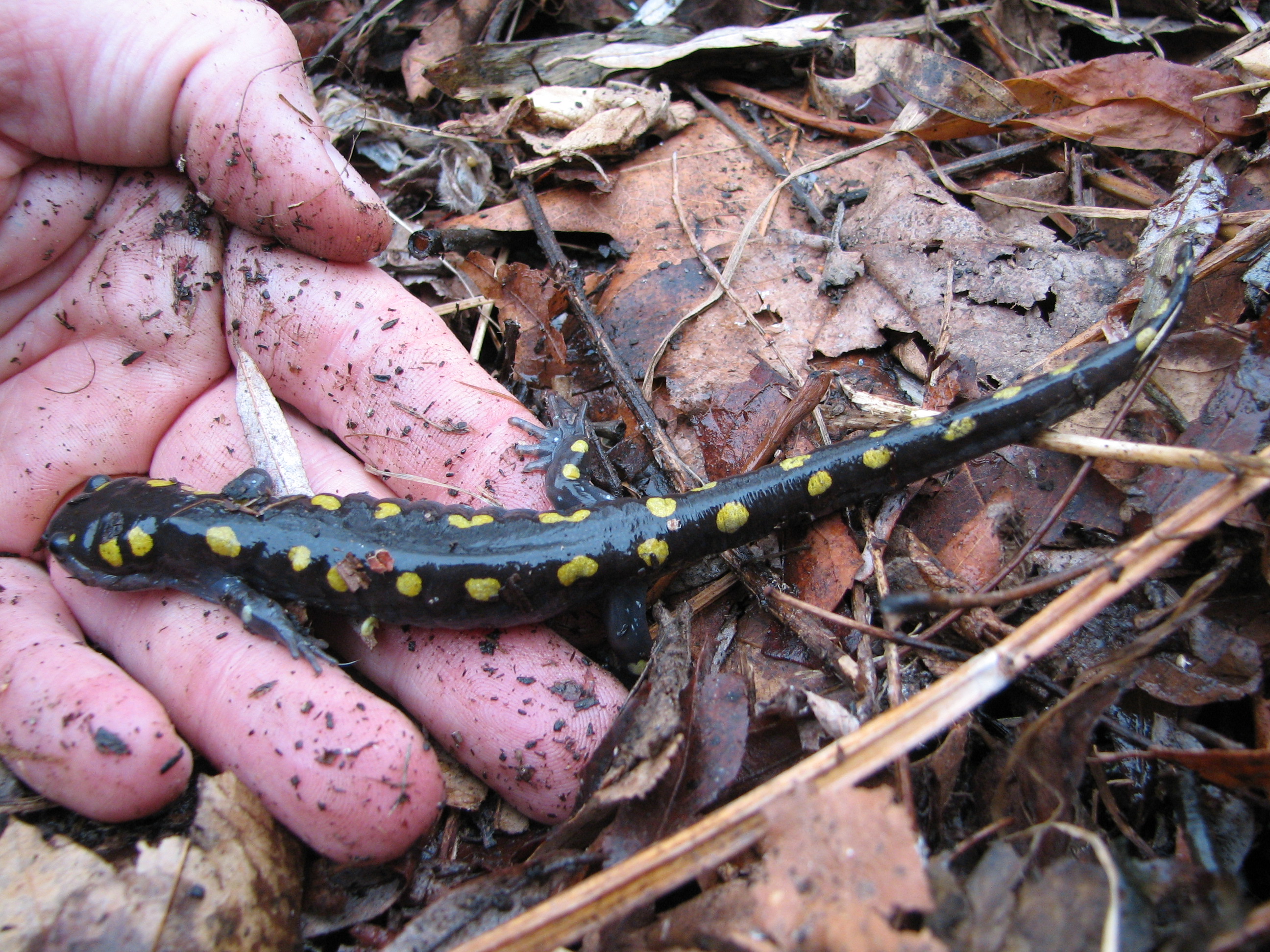
During spring, the frogs and toads become noticeable with their loud chorus of mating calls.  The Wood Frog begins earliest, followed by the Spring Peeper.  As the weather warms, Pickerel and Leopard Frogs, Gray Tree Frogs, American Toads, Green and finally Bull Frogs start calling. Two salamanders commonly found are the Yellow-spotted and Red-backed.

Animal Spotted Salamander

Yellow-spotted Salamender

Reptiles tend to find Maine too cold.  A few hardy ones are commonly found, including Snapping Turtle, Painted Turtle and rarely the Common Musk Turtle.  The Snapping and Painted Turtles often come onto my property and lay eggs.  The Garter Snake is the most often spotted snake, rarely the Water and Milk Snakes.

I have not yet mentioned the tremendous variety of plants and invertebrates found in and around the pond.  There are thousands of species of plants found locally.  I have not found anyone who has cataloged this diversity to its full extent.    Protecting Taylor Pond, its water quality as well as the quality of its watershed, protects these plants and animals for future generations to enjoy.

Ice-out occurred this year on March 26th, the earliest I have ever experienced.  At a state water conference two years ago a scientist reported that a review of records on ponds in Maine, extending back over a hundred years indicate that ice-out is occurring now earlier than ever.  Observations of our natural world, dutifully recorded, reveal issues of global significance.  At 239 feet of elevation we will not need to worry about our homes if the oceans rise with global warming.  However, the ice fisherman this year had the shortest season in a long time; they barely got their houses off the lake before the ice melted.  As I sit writing today, the ducks have taken advantage of the open water; American Merganser, Ring-neck Ducks and Golden-eyes have stopped off in the pond on their way to breed in Canada.

Maine Boating Laws

by Susan Trask, June 2005

Several times each summer, it seems, the Taylor Pond Association receives complaints of folks violating boating laws. Somebody is wake-jumping with a jet-ski; someone is going too fast near a shoreline. Every year at the Annual Meeting, someone suggests that we consider putting some restrictions on boating. I was amazed when I went on the State Inland Fisheries and Wildlife Website and saw just how many lakes and ponds in Maine have instituted boating restrictions! So far, we have not gone that route at Taylor Pond. However, the TPA does hope and expect that local boaters will adhere to the State safety regulations. These reg’s not only protect personal safety, but also help to preserve the health and viability of the resource we all treasure.

Here’s an outline of some of the most useful safety regulations:

Personal water craft:

  • Anyone operating or riding a PWC must wear a personal flotation device (i.e. life jacket).
  • PWCs may not be operated during the hours between sunset and sunrise.
  • A person is guilty of “imprudent operation” if one “engages in prolonged circling, informal racing, wake jumping, or other types of continued and repeated activities that harass another person.”

Waterskiing:

  • A watercraft towing a skier, surfboard, or aquaplane, shall not operate within the water safety zone (i.e. 200 feet of the shoreline), unless taking off or depositing the skier back to shore.
  • A watercraft towing a skier, etc., must have a person aboard (in addition to the operator) who is at least 12 years old and can continually observe the person being towed.
  • You may not tow someone on water skis, etc. between the hours of ½ hour after sunset and ½ hour before sunrise.

Speed:

  • Watercraft may not be operated at a speed greater than “headway speed” (the minimum speed necessary to maintain steerage and control while the craft is moving) within the water safety zone (200 feet of the shoreline). “The operator must consider the effect of the wash or wave created by their watercraft to waterfront piers, floats or other property or shorelines.”

General safety:

  • For craft under 16 feet, you must have one wearable PFD for each person aboard. For craft 16’ and over, you must also have a throwable (Type IV) device on board.
  • Children under 10 years of age must wear a Type I, II, or III PFD while one board all watercraft.

For a complete reading of Maine’s boating regulations, go online to the State website, or pick up a booklet at Auburn Hall. A stack of these booklets sit right on the counter where you go to register your boat or car.

As you take to the water this summer, please respect the health and safety of your fellow boaters and swimmers, as well as the health of Taylor Pond itself. Try to really pay attention to amount of “wash” your boat creates on the shoreline. Think of it in terms of the extra phosphorous-laden soil that dumps directly back into the lake with each wave! Cultivate those good habits that will help to maintain the high quality of the beautiful lake we all enjoy and share!

Nature on Taylor Pond 2005

by Dana Little 6/19/05

The ice on the pond closed in December this year. Just before it closed the migrating ducks moved through: small groups of Hooded Mergansers, American Mergansers, Buffleheads and Goldeneyes. These ducks joined the loons who remain on the pond until the ice closes in. They stuff themselves with fish, mussels, snails, crayfish and frogs. The mergansers will sit on the surface bobbing on the waves until ready to fish. When fishing they swim with just their heads submerged looking for prey. When they spot a likely fish they dive rapidly, catching it in their serrated bill. If you watch carefully, as they surface, you will notice they flip the fish up in the air and swallow it head first so that the spines on their fins do not catch in the throat. After they fatten up in the pond, and the ice chases them away, they travel down to the coast for the winter, feeding in the ocean. In spring they will return once again on their way to Canada to breed. Only the Hooded Merganser and the Loon remain to breed on the pond.

When the pond froze solid we had a couple of weeks of good skating. At night the ice expands as it freezes. The ice seems to sing and groan from the stress. Sometimes the ice cracks beneath as you skate along. A starry night with the moon shining and the ice singing is an unbeatable experience. We had a few nights where we saw the Northern Lights but they were not as spectacular as last winter. The ice boats made it out a couple of times and achieved some remarkable speeds.

This winter the ice fisherman were busy. Five ice shacks were erected for protection from the bitter cold north winds that cross the frozen snow. Many fisherman did not have a shack and just wore their warmest clothes. The prize for their efforts included many large pickerel, bass and perch, as well as the privilege of being outside in a beautiful spot.

Wendell Nason spotted a deer carcass on the ice just before it broke up. Over the next few days he spotted many crows visiting the site. A Bald Eagle made several visits to feed on the meat, as well as a coyote. Once the ice opened up muskrats could be seen diving for mussels which they would bring up onto the ice and eat.

In the winter of 2003-2004 a Mr. Tufts came at the behest of some of our neighbors and trapped 5 beaver off of the marsh on my property. The beaver are trapped underwater and drown. When we protested, the game officer pointed out that Mr. Tufts needed no permission to trap if he could access the beaver lodge from the frozen pond. This last summer, after intensive trapping all winter, we noticed three large beaver swimming about, no young, however. My reading tells me that trapping does not decrease the beaver population. If all the beaver are removed, new ones move in; if not all beaver are removed, they reproduce at a higher rate due to less competition for food. I know that Beaver cause much destruction as they have cut down a number of my crabapple trees. Four-foot-high turkey fencing firmly staked provides the best protection. Two years ago they tore off and reached over three-foot-high chicken wire to neatly cut down my young trees.

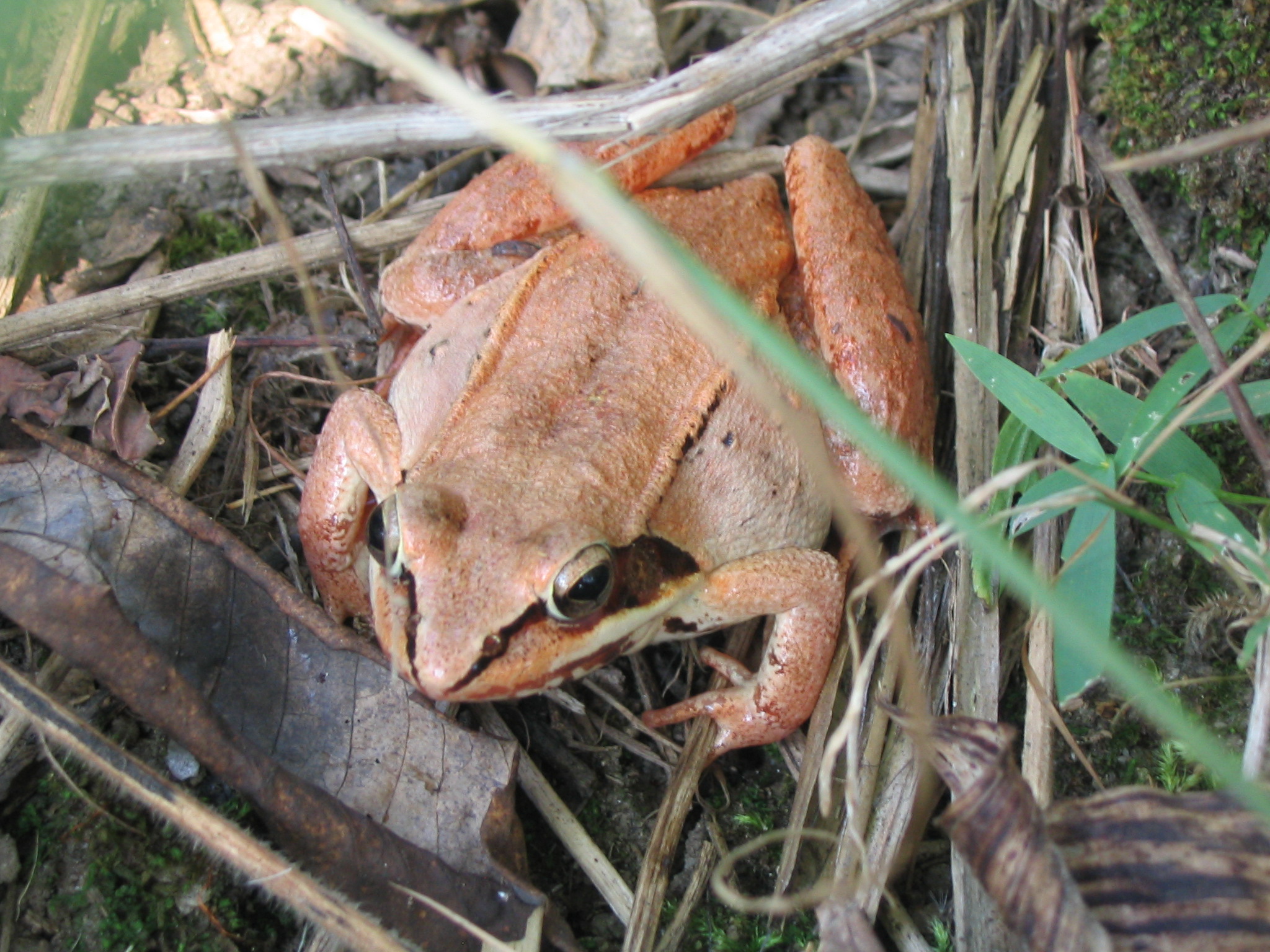
April 8, before the ice and snow were gone, the Wood Frogs started announcing their mating season. By April 22nd egg masses were spotted in the marsh. Spring Peepers started singing the next week and then the Leopard Frogs the following week. Early May the Common Toad began its chorus and the Green Frog was heard first May 20th. When the Bull Frogs begin singing in June we know that warm weather is upon us. On warm and rainy spring nights the amphibians move about. Large numbers of frogs and toads can be seen crossing the roads around the pond. May 21st my son went out with his flashlight and found a half dozen Yellow Spotted Salamanders crossing Garfield Road. Twice that many had been killed by cars. Black with yellow polka dots and up to 9 inches in length, they were spectacular to see. I know of one community in Massachusetts that values its salamanders so highly that it built a tunnel under the road to allow safe passage.

Frog Wood

The first to be heard in the spring, a Wood Frog.

In early April we were flooded out with 5 inches of rain over a couple of days that melted off the winter’s accumulated snow. People who have lived here longer than myself tell me the pond was at its highest in 20 years. We had a few days where we had to canoe down the driveway to get home. The level rapidly dropped and we were grateful that we did not have to ferry the groceries in the canoe. The beavers swam all around the house. One morning on my way to work the beaver kept slapping his tail at me as I waded down the driveway to my parked car. The beaver seemed to be telling me that this was beaver, not human, territory.

Taylor Pond Water Levels & Flooding Report

By Marc Tardif, 7/3/2013

Last year, the TPA newsletter included an article by Dana Little and Susan Trask summarizing some of the many considerations associated with water level control. The article was largely in response to inquiries the board received from the general membership concerning the extensive flooding we experienced in June of last year. To further address membership concerns, the board established a water level committee with the task of identifying the natural and manmade influences having the biggest impact on water levels and flooding. The ultimate goal of the committee is to determine if viable opportunities exist to reduce the extent and duration of flood events. The board does not endorse control of normal water levels on Taylor Pond, and the water level committee is not engaged with any activity in that regard.

Over the past year, the water level committee has been very active with field surveys and meetings with professionals knowledgeable in hydrology and local conditions. The committee would like to acknowledge and thank the following organizations for their contributions of time and expertise which has led to the preliminary conclusions contained in this report: Stony Brook Land Use Consultants; Jones Associates Land Surveyors; John Field Geology Services; Auburn City Engineers office, Auburn Water and Sewer District, and the Auburn Public Works Department. A substantial amount of information has been provided by these sources and will be made available to view on the TPA website.

Flooding is a function of the broad and complex subject of hydrology. There are three primary factors that affect the extent and duration of a flood event. 1) The amount and rate that water is introduced to the watershed. 2) Storage capacity of the watershed at the onset of precipitation. Before flooding occurs, features in the watershed that are capable of holding water need to fill and overflow. This includes depressions in the land, soil saturation, dams, and the pond itself. 3) The rate at which water is allowed to exit.

Taylor Brook is the primary outlet for water exiting the pond in both normal and flood water conditions. Six features of the brook have been identified from the pond outlet to the Kendall Dam 1.5 miles downstream that affect both conditions in and around Taylor Pond. The brook elevation drops dramatically immediately after the dam, so there is no impact on the speed of pond water level recession from conditions located further downstream.

The first feature effecting the time it takes for water levels to recede is the fact that there are only two feet of elevation drop over the 1.5 mile stretch. The very gradual slope provides minimal energy to move water downstream and away from the pond. Thick vegetation throughout the stream course further reduces flow rates and results in what can be described as a very sluggish waterway.

The second feature of interest can be found a few hundred feet downstream from the pond outlet. Here we find a heavily vegetative area rooted in silt deposits that have raised the bottom of the stream channel. This raised area is referred to as a berm and extends the full width of the brook. The bottom of the channel in the berm area is higher than any other point along the 1.5 mile course. The significance of this naturally created feature is that this is the point where water would stop flowing from the pond and into the brook under receding low water conditions. Water levels below this elevation would be the result of water exiting by ground infiltration, evaporation, and transpiration. The berm has little or no significance relative to flood water dynamics.

The third significant feature is located just downstream of the berm where two culverts are installed at the point that the brook passes under Hotel Rd. Unlike the berm, this feature has no effect on normal water levels. However, under flood water conditions, this feature acts as a dam of sorts that limits pond discharge to the maximum flow capacity of the culverts. Another negative characteristic associated with this feature under flood conditions is that large amounts of water accumulating from the downstream Taylor Brook watershed backs up against the culverts further reducing water discharge rates from the pond.

The fourth feature encountered traveling downstream from Hotel road is a large beaver dam located adjacent to the Granite Mills Estates development. The dam traverses the entire width of the brook, and water elevation drops one foot between the upper and lower sides of the dam. This feature doesn’t have much if any effect on normal water level since its elevation is slightly below the height of the berm. The dam does have some negative impact on mitigating a flood event in that the water volume retained by the dam is volume that is not available for storage of storm water accumulations.

The fifth feature of interest is the slab bridge located on the driveway to the Kendall property. This is probably the most significant manmade influence affecting the time it takes for flood water levels to recede. The bridge acts in the same manner as the Hotel Road culverts by restricting flow rates. The restricted flow at this point exaggerates the backed up water condition at the Hotel Road culverts. The only impact this feature might have on normal water levels in the pond would be the slight increase in the time it takes for water levels to recede.

The sixth and last feature to discuss is the Kendall Dam which is located just below the Kendall driveway bridge. The dam has a higher flow capacity than the bridge, and is equipped with a currently inoperable sluice gate which might be used to further increase flow in a flood event. Flow restriction over the dam is somewhat moot at this time since the upstream bridge is more restrictive than the dam. The dam has little or no effect on normal water levels in Taylor Pond since the elevation of the dam’s spillway is below the berm elevation. The Kendall dam has the same effect as the beaver dam under flood conditions in that the volume of water retained by the dam is volume not available for storage of storm water accumulations.

The information used to prepare this report is reliable and adequately detailed to support the conclusions expressed above. Given the heightened level of understanding we now have, several options to reduce the extent and duration of flood events have been suggested. The most promising options entail methods to increase the flow capacities of the Kendall Road Bridge and Hotel Road culverts. Unfortunately, the existing data we have is not adequate for the purpose of quantifying the extent that any one feature contributes to the overall problem of flooding. If undertaken, the next step in this process would involve an  expert analysis to determine benefits which would be realized by modifying existing features. The value of any proposed benefit would need to be weighed against the cost to implement modifications. To be viable, several state and local authorities having jurisdiction would need to be on board with the process. The concerns articulated by Susan and Dana in the 2012 newsletter remain pertinent and should be revisited before additional action is taken.